Junior Karting Helmets

I hadn’t budgeted on getting my son a karting helmet: he already had a really funky motorcycle helmet that he had used for arrive/drive karting and, as he wasn’t going to be MSA racing for some time, I saw no need. Unfortunately I then started thinking about it more – if I was going to get him an MSA-approved helmet later in the year, I might as well get it now and rest assured that he has the best protection possible. Of course there is always the question “How much do you value the contents of the helmet?”. It’s hard to argue with that so which helmet to get?

For MSA racing, under-15s require a helmet certified to the Snell-FIA CMR2007 standard. The most common choices are the Arai CK-6, the Bell KC3, the Koden CMR2007 and the V2 CMR. Next you want to find out what size you need – the SHARP Helmet Safety Scheme Guide is a great resource for finding out how to measure your head and how to test a helmet’s fit. Then you want to find a shop that sells not only your preferred helmet but as many as the others as possible – don’t just order one off the internet as I did!!! Head sizes differ and it may be that your head isn’t good a fit for the helmet you thought you wanted and returning helmets via the post is an expensive business – I speak from experience 🙁

I discounted the Koden on appearance and comments from Dads whose lads had upgraded from Kodens to other more highly regarded helmets and opted for the Arai – partly on reputation and the fact that you see a lot of them on the track and I ordered online as it was the best price and came with a free spoiler kit. When it arrived, my son complained it was tight on top of his head. After making him try it on at least a dozen times and keep it on for 20 mins in a bid to get used to it, I stupidly ordered a bigger one assuming it would be fine – it was too big. Needing to resolve this because my 14-day return deadline on the two Arai helmets I now owned was rapidly approaching, I went to my local shop, had my son try the Bell in comparison with the Arai and bought the Bell in the size that fitted the best. The good thing about the Bell helmets are that they come in individual sizes i.e. 54cm, 55cm, 56cm etc whereas the Arai comes in size ranges i.e. 54-56cm, 57-58cm etc. The Arai also has a larger visor area compared to other Arai motorsports helmets (I was told they had to have a little less helmet/make the visor larger than their other motorsports helmets in order to stay within the maximum weight permitted under the standard) which, to my eye, makes it look a little more WSB and less F1. Returning the two Arai helmets, including insurance for £800 cost me £30. The kicker was the store charging me £5 to cover the ‘free’ postage they had offered. After all of the haggling I’d been doing to save money, I’d just wasted £40! We won’t talk about this again, ok?

Total spent so far: £1935

Buying a kart (part 2)

I’ve done nothing but spend my spare time on karting stuff since Christmas – the whole towing/kart finding/learning/bartering process has been more stress than I typically have to endure but… here she is!!!

kart

It’s a 2009 Tonykart EVR which, as you can see, is sitting on top of my fairly low-tech trailer lid!!! Having it in the garage takes a huge weight off of my shoulders! I’d been monitoring two karts for some time: this one, which was offered to me before Christmas through one of the Karting forums, and a 2011 Wright which had been relisted on eBay in numerous packages with varying levels of completeness. Unfortunately both sets of negotiations came to a head at the same time: I agreed to buy the Wright, got cold feet and luckily this one was still available (always go with your gut feeling!).

I had negotiated a price/package with my seller over the prior weeks that included the rolling chassis, complete engine (from airbox to exhaust), used slicks on rims, used wets on rims and a trolley for £700. In addition I was buying the following extras to the tune of £300: Mychron 4, remote starter, new slicks, kart cover and a comprehensive spares package. I don’t feel at all comfortable haggling with people so did it all via email rather than in person so that I could negotiate harder than I otherwise would. If I were the seller, I’d have told me where to stick my initial offer but there is no point in starting high – it will just cost you more!

The day began with my second towing journey – no problems there although I did have to learn how to use ratchet straps (tip: much easier to figure out when you are actually wrapping it around the trailer than testing them on the lounge floor). Met the seller at Clay and spent the day learning what I could about being a mechanic whilst my son set about trying to find the 10 seconds that he had been off of the pace when we had rented a kart a few weeks earlier. Bump starting was a much harder task with this kart compared with the rented kart and I soon had to make way for the seller and his to do the starting (and even then they were running around the first bend trying to get him going). We also had to spend some time adjusting the things, including installing a smaller seat, to accomodate the difference in size between the new and former owner which necessitated a first ever purchase from the shop at Clay (pedal extensions – £25). The timing of the purchase wasn’t great – my contacts were unable to make it on the day to give me an expert opinion on the chassis, which was a concern as the kart had been involved in an accident in it’s last outing in October. I had been assured that the kart was straight and that there were no cracks, rust or flat spots – everything looked ok to my untrained eye and, unless was prepared to spend the £50 to get it checked on a jig, I was going to have go on trust/take a punt.

So after a day’s testing, in which my son was still 8 seconds off the pace (but had a great time which was far more important in only his second day in a ‘proper’ kart), I parted with the readies and also bought a couple of extras that weren’t part of the original deal (spare carb – £30, transponder – £40, Tillett R4 rib protector – £25). Then, as if by magic, one of my contacts came along and started inspecting the kart and asking a lot of questions – and then he pointed out a small crack just off a weld on the front end. Gutted!!! What could I do? I’d paid for the kart and, although I trying to back never crossed my mind, I knew that a crack or weld *significantly* impacts the value of a chassis. I pointed it out and the seller offered my another carb – basically 10% off the chassis. That didn’t make up for the crack but I didn’t feel I had much choice but to take whatever charity was offered. So I loaded all the bits in the trailer and the boot and the back of the Clio and the footwell around my son’s feet. Then we set about fixing the kart to the trailer before heading for home, £1120 poorer but with a pretty decent entry level kart (with crack) and two feet firmly entrenched into the world of karting. The journey was a little nervous – checking my mirrors every 15 yards to see if the kart moved and we got all of 25 yards down the road before pulling over to remove the kart cover which was clearly going to disappear very soon! Other than that the journey was a smooth one.

Total spent so far: £1610 (£110 over budget!!!)

Buying a kart (part 1)

There is *so* much to consider when buying a kart. You need to set a budget and pick a class (see ‘How Much Does Karting Cost?‘). Having spent two months watching karts sale on the karting forums and on eBay, I developed a reasonable picture of how much things would sell for and the kinds of questions that must be asked when enquiring about karts for sale.

Which class – rotax or TKM?
My budget (£1500 in total – £650-£700 for a complete kart, moving upto £1000 depending upon how comprehensive the spares package was and £500 for a trailer/towbar) essentially ruled out rotax so I only looked at Junior TKMs.

A complete kart with spares package or a rolling chassis on which to build the kart?
I settled on a retirement package – they seem to come up frequently enough that finding one within reasonable travelling distance should be possible and they offer great value for money when compared to buying the necessary bits individually (rolling chassis, complete engine (airbox > exhaust), slicks/wets, Mychron, trolley, starter, a spare carb and a few chains/sprockets – it soon adds up even if you decide you don’t need all of the above) although I was wary of over-valuing any spares package (as sellers tend to do) given I might not end up ever using some of the bits (or even identify them!). If you know what you are doing and are happy to wait for the right prices then the rolling chassis route may be more feasible for you than it was me!

Which engine type – direct drive, clutched or TAG?
I favoured direct drive as they are cheaper (a bit less than clutched and a lot less than TAG) and require less maintenance. Some say they are quicker but cost was the primary consideration. The only downside is bump starting – I rented a direct drive kart from a member at the local track to satisfy myself that this would not be a problem so never really considered the alternatives.

Where to buy?
I’d recommend the local kart club first of all – they may know of members selling up or changing classes and I found them *extremely* helpful (thanks, Derek!) and full of very good advice on what you might want to be looking out for. I definitely would not have decided to go for it were it not for the help of the kart club and members whom I met in the karting forums. Failing that then the best sources are the Karting.co.uk Market Place and the Karting1.co.uk For Sale forum (the former seems to get more items listed) and, of course, there is eBay. I watched a lot of karts go on eBay; the impression I get with is that you really need to know what you are looking for here as, whilst there may be the odd bargain to be found, there is probably an awful lot of stuff that nobody else wanted (although it’s a great source for spares and some of the little things that you will find you need later on). Your best bet is to find something that the seller is happy to bring to your local track, where you can try it out, see what you are buying and hopefully have one or two friendly members pore over it before you hand over your money.

Questions to ask when buying a kart/chassis:
Where/when was the kart last used/raced? (you can lookup the previous results on the club’s result page and check for DNFs if you are as paranoid as me!) but also be a little wary of a championship winning chassis – they won’t necessarily have had the easiest of lives
What is the serial number of the engine?
When the engine was last rebuilt and by who? (you can verify this with the rebuilder)
How many hours since the last rebuild?
Is the chassis straight/when was it last checked?
Does the chassis have any cracks/rewelds/rust/flattening? (any chassis issue will heavily impact the value of a chassis)
What sized seat is included?
In what condition are the tyres?
What is the condition of the bodywork?
Exactly what spares are included?

If I was going to spend my full £1000 budget, I wanted to ensure that my spares package included a decent set of slicks and wets both on rims (the MSA approved wet tyres changed for 2013 so, whilst you can practice on anything, you need this year’s wets to race in any MSA events after April 1st), a Mychron 4, a trolley (*essential*) and a remote starter.

My first obstacle

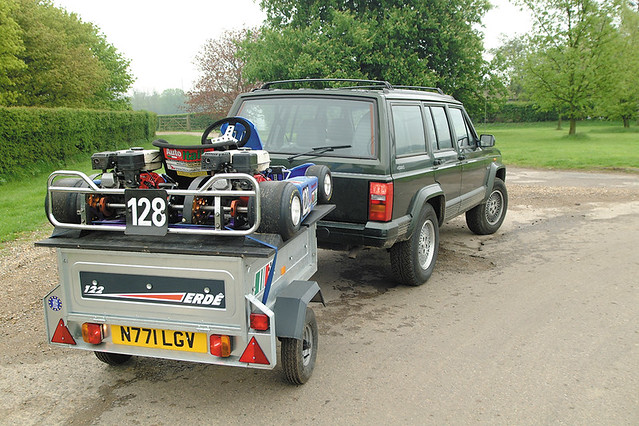
The second purchase of my (our!) karting career – a 5’x3′ Franc trailer with jockey wheel (uber-important when you will be dragging a kart around on top of it), cover and spare wheel. I’d been looking at trailers on eBay, Gumtree, Preloved and Trade-It but found this one was still for sale on the Karting1 forum having initially discounted it. A steal at £225 🙂

trailer

Towing was a really big obstacle for me – everything about towing (towing capacity, trailer gross weight, weight distribution, noseweight, hitchlocks) was alien to me until now. The trailer was further away than I was really hoping to travel and it would be fair to say I was in fear of towing a trailer up the M4. My fears were unfounded and, although it bounced around a bit and I was overtaken by lorries (including six artics!) for the first time *ever* as I tiptoed down the A34, it all well very smoothly and I held my own on the motorway 😉

With the limitation of towing behind a Clio, I was very keen to get a fairly lightweight trailer that would fit inside my (hitherto full of junk) garage and obviously the smaller ones are cheaper. A kart measures roughly 6′ x 4.5′ so I was keen to go for a 5’x3′ trailer and not a cheaper 4’x2.5′. My inspiration came from this Flickr image. I have my 12″ thick 6’x4′ ply sheet and some timber to make a frame; the plan is to sit the kart on top and ratchet strap it down.

Some alternative ideas that were discounted (the left image looks the part but has no cover for the trailer contents, the right uses a 7’x4′ trailer – a little large for car and garage):

9028tn_Dax 218 kart

Total spent so far: £490 (towbar, trailer, ply sheet, timber) – £10 under budget!!!

The Three Big Questions #3: How much does karting cost?

So your son is going to love it and you’ve decided you are up to the challenge so now it’s all down to the money – how much will this all cost? Unsurprisingly, it really depends upon how seriously you are going to take it and how much you are willing to spend (it will use up whatever budget you have and then some!). The up front costs are more visible, it’s the ongoing costs that mount up. To start with you need to decide on a class – Junior TKM is generally accepted to be cheaper than the Junior and Mini Rotax classes (there is plenty of discussion to be found on which class is preferred and Spellfame’s overview of the various karting classes is very informative) although it may boil down to what is popular at your local track. You must then set your budget for your kart – will you opt for a complete starter package or are you going to buy a rolling chassis and build up the kart from there? Then there are the things that you will need to have when you arrive at the track for the first time – tools, racewear, fuel and we haven’t gotten to the maintenance side of things yet!

I was aiming very much at the entry level; I have friends who bought karts for their sons at the same time but whose budget was up to three times the size of mine! Here is the list of items that figured in my karting costs spreadsheet along with the costs I factored in, obviously you may not need all of this…

Initial costs:
Kart – complete Junior TKM kart and a decent spares package* (£1,000)
Towing – towbar fitted, camping-style trailer (£500)
Racewear – racesuit (£100), rainsuit (£20), rib protector (optional – £60), neck brace (optional – £30), CMR 2007 certified helmet for MSA racing (£150-£400)
Track membership – Clay Pigeon offer members £5 off every practice session (£35)
ARKS pack – only necessary if MSA racing (£50)
ARKS license test – only necessary if MSA racing (£90)

Karting costs:
Practice day – £40 per day
Race day – £47 per day
Transponder hire (if racing and don’t own one) – £10 hire per day

Consumables:
Race slick tyres** (3-4 race days per set) – £130 per set
Race wet tyres** (1-2 sets per year) – £130 per set
Chains – £20 each
Sprockets – £15 each
Fuel (~5 litres per day @ 135p/ltr + oil) – £8 per day
Petrol to get to track (2 gallons per trip) – £12

Maintenance:
Engine rebuild (every 8-12 hours) – £250-£340 depending upon who
Carburettor clean (every 3 sessions) – £15

* Make sure you get a trolley, preferably spare tyres/rims, sprockets, chains, a seat that fits and any spare body/chassis bits you can!
** Whilst your son is getting up to speed, he won’t be wearing the tyres out as quickly

The Three Big Questions #2: Is this for me?

Probably the biggest barrier to buying a kart was concern over whether the Dad/Mechanic role was really for me. Walking around the paddock area and watching the Dads busily tinkering between every session really made me doubt whether I would a) be able to do it and b) enjoy doing it. I’ve never been mechanically minded; I didn’t really know how an engine worked; what a piston did, or a carb, crankshaft – you get the idea. I spent a lot of hours reading forums such as those found on the karting1.co.uk and karting.co.uk, as well as collecting strange looks from my other half as I watched YouTube videos such as ‘How A Carburetor Works‘! In the end I concluded that, whilst kart maintenance was something definitely out of my comfort zone, I was going to go with it – hopefully I’ll pick enough of it up to get by in the first few months.

As it turned out, there was a second part to this role I had not foreseen – transporting the kart!!! I own a Clio and changing cars was definitely not something I was prepared to do. Obviously if you have a van or a nice 4×4 then this might not be an issue for you but I *really* did not fancy the idea of towing. I looked around for lightweight options and quickly realised that trailers like this weren’t going to be in the running and it was only when someone recommended the camping trailer and board approach that I became more open to the possibility of towing. It still feared me with dread – what with the kerb weights, towing weights, noseweights (there’s a great resource to be found on the National Trailer & Towing Association web site if you want to find out more).

I wasn’t overly convinced about maintenance or towing and my clearance of this hurdle was more of a slump over than a jump but never mind – onto the last question…

The Three Big Questions #1: Will my son enjoy karting?

So your son (or daughter for that matter) has done the arrive/drive thing and you’re thinking about buying your own kart? Before taking the plunge and sinking not an insignificant amount of money into karting you need to be absolutely certain that this is the right thing for you both. To this end there are three questions to which you need to be able to answer ‘YES’. The first:

Will my son enjoy karting?

Assuming you’ve some arrive/drive experience (if not then look for something like Teamsport’s excellent Half-Term Karting events – I can’t recommend these highly enough as a first place to kart) then you really need to get yourself to a track and watch a race or practice day. There is a *huge* difference in performance so it’s a good place to gauge not only what you both think of the speed difference but also what else goes on in the background (more on this later). If you like what you see then contact the local karting club to see if they stage open days where potential new members can try out the different classes of kart. This really is the best way to determine whether or not your son is going to enjoy karting. Our first time was a bit of a mixed bag (early spin = loss of confidence) so we rented a kart from a friend and did a practice day a few weeks later: he was a rolling road block at times but absolutely loved it and didn’t take anybody else out.

Question 1 = answered 🙂


What am I doing???

It’s been little over a month since I seriously started considering getting my son a kart of his own. I’ve never owned a kart before and I am about as far removed from being a mechanic as it is possible to be; to the point I gave up on my petrol hedge trimmer after two months as I didn’t like messing with the choke, the petrol and the fumes!

Since my son was deemed big enough to drive an adult arrive/drive kart around 18 months ago, I’ve been indoor karting with him – prior to that I’d karted four times in 40 years! Things have snowballed since looking to get him a free test in a ‘proper’ kart a few months back and I’ve spent a month investigating the costs, the options, trying to pick up everything I could to make an informed decision on whether to take the plunge and buy a kart. I figured this blog might actually help others in a similar position, whilst also allowing me to think out loud and maybe get some expert opinion where things get vague (I am a noob, remember!).